
By Sophia Cohen
For nearly five decades, painter John Alexander has watched the East End evolve from a quiet enclave of farmers, fishermen, writers, and artists into the glamorous destination it is today. What began as a chance encounter with Willem de Kooning in Houston ultimately led Alexander to Springs and then Amagansett, where he built both a home and an artistic practice deeply rooted in the rhythms of the landscape.
This conversation is personal for me. Alexander is not only an artist whose work I have long admired, but also my father-in-law. Over the years, I have come to know him not just through his paintings, but through long dinners and family gatherings where he shares stories about the East End he has called home for nearly half a century. Here, he reflects on the larger-than-life characters who have shaped his life, from Larry Rivers and John Chamberlain to Bill Murray and Lorne Michaels. Along the way, he sounds off on old Amagansett, life in the studio, and the enduring curiosity and light that continue to animate his work.
When did you first settle in the Hamptons, and what brought you out there?
In 1976, Willem de Kooning made his one and only trip to Houston. He had a dear friend who lived there. She knew what a fan I was and said, “Would you be willing to take him around?” I was 31. I couldn’t believe it. We got on like a house on fire. The highlight of the trip was taking him to the Rothko Chapel. He got very overcome and emotional, so I left. I said, “Listen, I’m going to step outside and let you do this alone.” About 20 minutes later, he came out teary-eyed. We had a long, long talk about that in Rothko.
And anyway, to make a long story short, He asked me to come to Springs [in the Hamptons] and visit him. So I got in my old El Camino and drove there that summer. Nothing at all looked like this. I mean, there were no modern houses, and all the mansions and stuff. It was just farmhouses and fishermen, and some artists and writers. I thought, There’s something magical about this. We rented our own house in ’80, and by ’85, I bought the property.
It was a Pan Am pilot you bought the house from?
Yes.
And the house was super funky, right? Very ’70s, very hippie.
Well, the whole bathroom in this beautiful old 1700’s barn was mirrors. Floor-to-ceiling mirrors. And it had a sunken hot tub in the middle.
I wish you’d kept that. That would’ve been fun.
I wouldn’t want to be in front of a wall of mirrors today, I can promise you. I just wanted privacy, so slowly but surely we began to encase the property with trees and stuff. And now it’s secluded, and the pond is full of lilies, and it’s a little bit of a hidden paradise in there. That took decades to do. I go out and paint by the pond. I draw all the time, in the yard.
The Hamptons landscape has greatly impacted your work.
The fauna and the flora have a profound effect on the subject matter of my paintings. I set up an easel outside. So many artists talk about how they came out here because of the light. I get my inspiration by staring at stuff, and then, like a jigsaw puzzle, I’ll take an image from here, from there, and build these complicated compositions.
So, you already spoke about de Kooning, but were there any other run-ins with the art scene early on with other people who were out here as well?
The great Larry Rivers, he befriended me. He was a very established painter at the time. And I became friendly with John Chamberlain, the sculptor, who had a big studio out here and maintained it for much of his late life. But much of it was writers. I was friends with a lot of the old, well-known writers of a different generation, kind of the Elaine’s crowd. Kurt Vonnegut, Joe Heller, George Plimpton. And what’s important to me is that most of the artists and writers that I was close to were all much older than me. They were wise, and had seen so much of the change in history.
How do you think the art scene has changed over the years?
When I first came here, there were a number of artists, but you could probably put them all in a restaurant. Now, there are bunches of them. And what we didn’t have before were galleries. There are galleries everywhere now. And they come, and they go.
You co-founded a vodka company with Dan Aykroyd, for which you designed the iconic skull bottle, and you’re very close with Lorne Michaels, of Saturday Night Live. How did you get connected to that group of people, who also have a connection to the Hamptons?
It happened by accident. I was still living in Houston, and a dear friend of mine, Van Schley, was a somewhat successful conceptual artist. He bought a minor league baseball team as a conceptual art piece: He was going to run the team for the summer and document every phase of it. And he was also good friends with a then-unknown Bill Murray. And when Murray was hired by Saturday Night Live to replace Chevy [Chase], Van said, “Why don’t you come through Houston?” My house was open to people in those days.
He came and stayed like 10 days or something. So we became very good friends, and not unlike the de Kooning incident. Because of him, I would go up and hang out at the show occasionally, and I got to know the other people involved. I just made a conscious decision that I really enjoyed being around comics.
What do comedians and visual artists have in common?
The really good ones are insecure. Myself included. I’m always asking, “What do you think?” Also, artists are very observant people. Comedians are very similar.
You’re one of the only artists with a studio right in one of the major towns of the Hamptons. Can you talk about how it’s evolved?
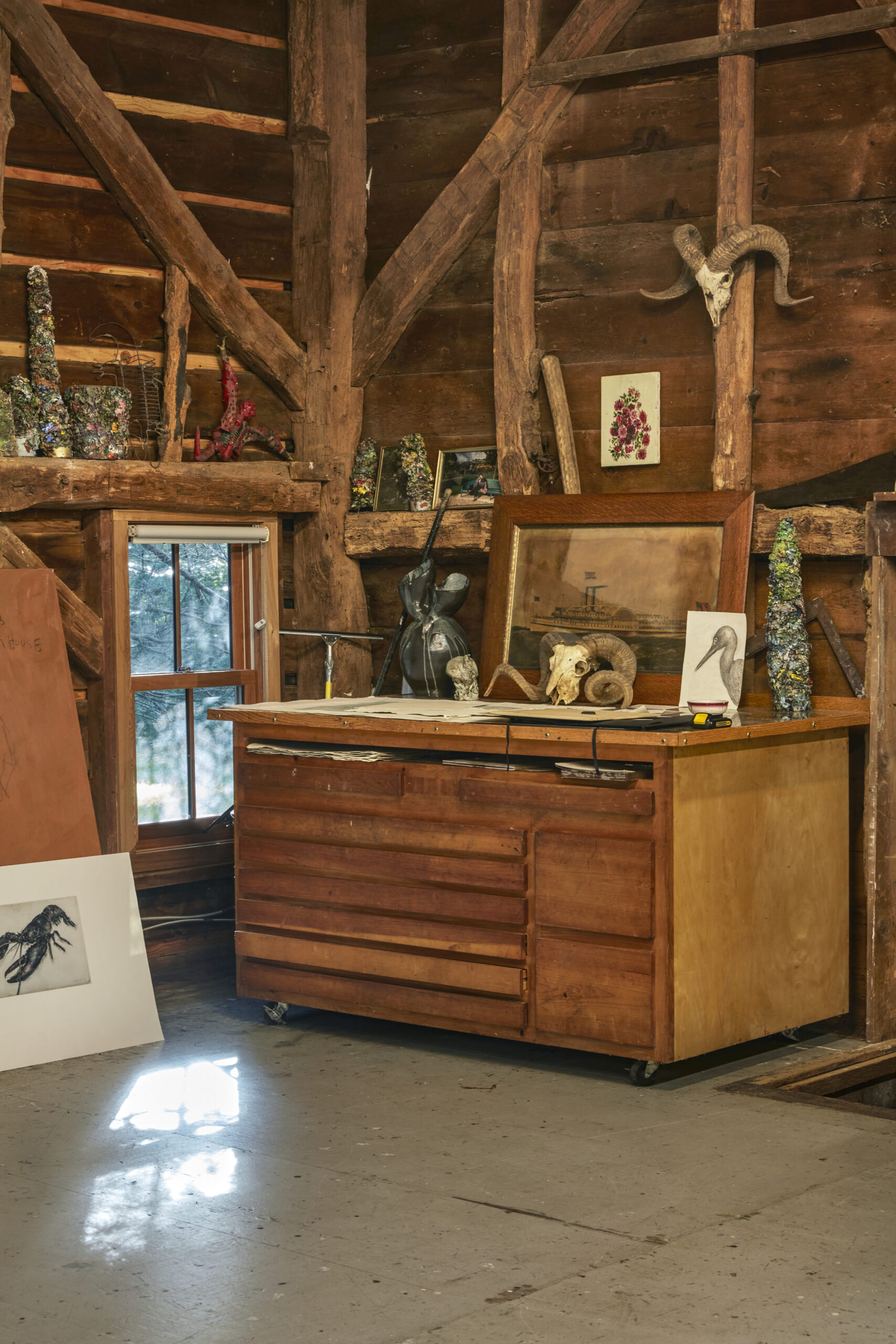
For many years, I didn’t even have a lock on the door. I’d just slide the barn door closed and go home at night. But then the town began to get bigger and everything began to change.
If you’re going to survive as an artist, there are several things you need to become successful. You have to have somebody talk about your art, so you can disseminate your ideas, and you have to show your art so that people can see it. Then you have to have a very important part that artists don’t like to talk about, but it’s real: you have to have a collector base. A community like this provides all of it, even though it’s rural. In the first years I was here, the only people that ever came by were the local fishermen, and the locals I knew.
I bet it’s now more annoying with [the Stephen] Talkhouse [bar] right next door, and now you have a bunch of drunk teenagers at night.
When I first came here, I was over there a lot because, in those days, it was old rhythm-and-blues artists. It was top-notch entertainment, and there were no massive crowds. Now, the night before last, there were probably 75, 100 people all around the Talkhouse, lined up down the sidewalk, trying to get in. It’s completely different.
Now you have drunk teenagers peeing behind your studio.
A hundred percent. And they go back there and do drugs, and whatever they do, but we do our best to keep them away.
You have your infamous “Keep Out” sign.
Well, the thing is, I like to work late at night, and I have always worked late at night. And I just don’t do it on Fridays and Saturdays anymore, because I just don’t want to be here when all that party scene’s going on.
You still have a pretty open-door policy for collectors, artists, and anyone who wants to pop by, which is great. Speaking of big collectors, my dad—we only learned this after Harrison [Waterstreet, Cohen’s husband] and I started dating—had bought some of your work. You were the first living artist my dad bought, ever.
Yes. This is long before I met you. I was introduced to him at a barbecue.
Larry [Gagosian]’s?
Yeah. Labor Day. The person who introduced us was going on about how he and his wife had my work. And Steve interrupted him and said, “I know John Alexander’s work.” I had no idea. He said, “You’re the first painter my wife Alex and I bought after we got married, we decided we wanted to start putting a collection together.” Marlborough Gallery, at that time, was the biggest gallery in New York. He said, “Why don’t we go there?” Coincidentally, my work was up and they bought a fairly large picture.
I have baby photos in front of that picture.
I used to do these politically satirical paintings, I still do, very kind of crazy things. So Marlborough calls me up and says, “Someone wants to commission you to do one of your satirical pieces of their friend’s wedding.” I’m like, “Oh, that sounds hard…” And he said, “Well, they’ll send you a photograph. Look at the photograph, and see if you can do it.” So they [Steve and Alexandra Cohen] send me this photograph of them at a table with a lot of food and wine glasses, and I had already done several dinner party satirical paintings with this kind of crazy stuff.
So I did this drawing, fairly large, like 30 [inches] by 36 [inches]. And I had a lobster coming up out of a plate, with its claws open. And I had fish flying through the air, and I had all kinds of weird things going on, and they liked it. And must still like it, because it’s hanging outside their bedroom door.
What’s crazy is it’s been hanging at the bottom of my stairs from my room my whole life. When Harrison and I started dating—you have a different last name than Harrison because you adopted him—I didn’t put it together, even though your signature is very legible on it. And then, I posted a photo, I think three months into dating, of my cousin’s birthday. In the back of the photo was the original painting we were speaking about, the one my parents bought when they were dating. Harrison thought I was being a stalker and said, “This is a little early for you to be doing that.” I didn’t know what he was talking about. And then we put it together, and lo and behold, we got married. So you painted a portrait of my parents for their wedding, and then we got married on your birthday, which also feels important to mention.
Well, what’s interesting, too, is that I met you with Fiona at another art dealer’s party. And coincidentally, Fiona was seated next to you. And I —
Tried to set me up with Harrison.
Yes. And then, there was some time after that, when you actually met him and got together.
Well, I was engaged to someone else. Let’s not forget that.
And also the dealer was Alex Berggruen, the son of John Berggruen, who’s my longtime dealer in California.
It’s fate. Last question: If you’re putting together a dinner party, which five people, alive or dead, would you invite to the Hamptons?
The yoga group: Ben Bradlee, Lorne Michaels, Paul McCartney, and Alec Baldwin. Oh, and John Eastman. He was its founder, and he’s a big collector. His dad was the lawyer for [Jackson] Pollock, de Kooning, Franz Kline. His son took over after his father died, and he put the yoga team together.
